From the hallway
A nine-month check-in from the two rooms I keep walking between: the studio and the school.

Last time I wrote from the 3 am feeding shift, a newborn asleep on my chest while I doom-scrolled AI news.
This week the chair is different. A Senate seat at the design school I came up through, agenda PDF open on my phone. The newborn from last time has grown. She’s in the carrier now, riding along while I edit this. Still on my chest. Just heavier.
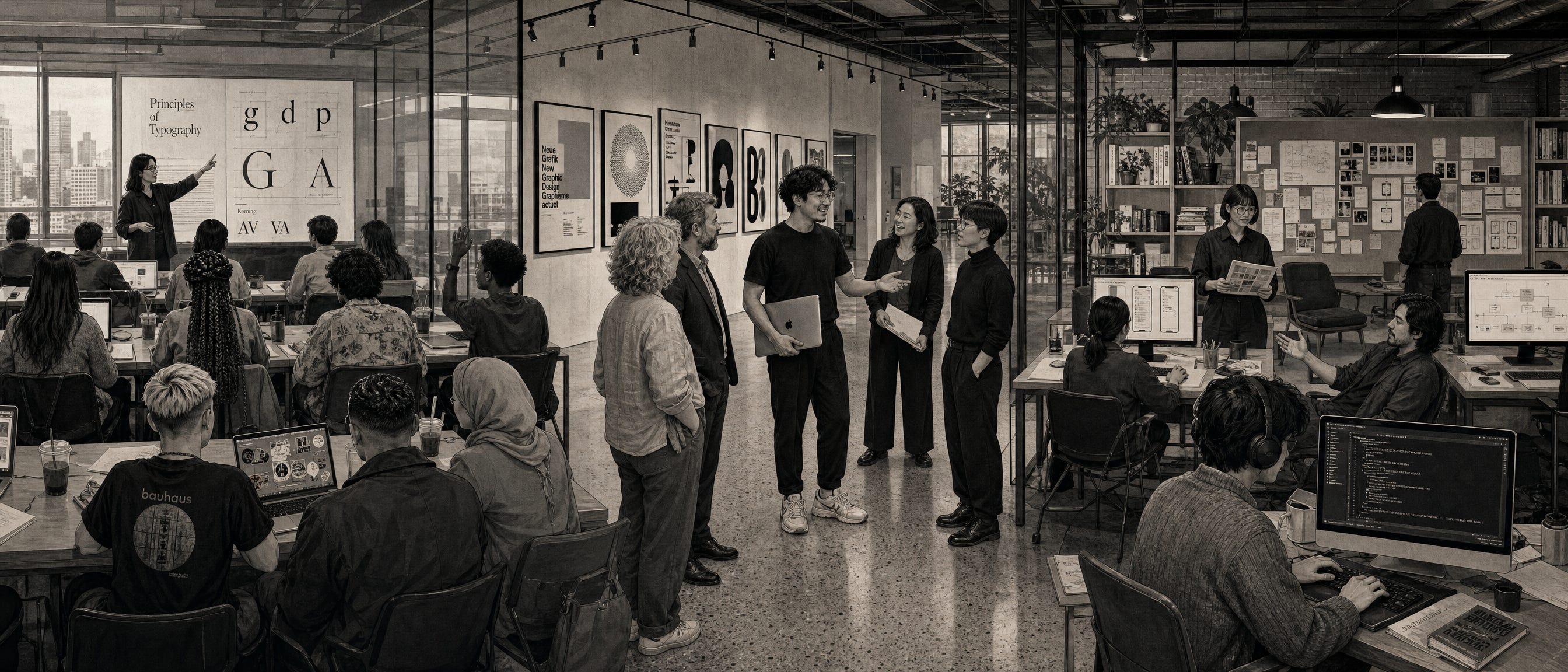
I wear two hats. One designing at a tech company. One helping govern the school I graduated from. I used to think of those as two jobs. Lately they feel more like two rooms. And the longer I do both, the more my real work happens in the hallway between them.
Because in one I’m helping push AI into the world. In the other, we’re still figuring out what it means.
Last August I wrote a piece asking whether creative universities were ready for AI. I was writing from inside the school then. Nine months later I think the more honest piece is about the gap between where I sat then and where I sit now.
Start with the school.
The thing I keep noticing is the gap between the hallway and the record. In conversation, AI is everywhere. In the formal channels, it’s barely shown up. Not in the policies. Not in the curriculum. And I have to own my part in that. I’m on the governance side, and I hadn’t pushed to change it either. This term I started to.
It’s not that schools are doing nothing. From what I can see, they’re talking to each other, faculty-to-faculty, campus-to-campus. Research grants for AI are flowing in, and many are getting approved. But the formal side still runs months behind the hallway. And on the grad show floor, the work that pulls visitors longest is still craft-led. Students haven’t dropped the hand. They’re negotiating with it.
Now the other room.
In the studio, the question isn’t whether to use AI. That was settled. This year, making it a top priority stopped being a suggestion. We’re held to it now.
For some of us that means daily use across the work. For others, designing the AI itself, from how it behaves to the screen the user sees. The expectation is the same. Central. Measured. Not a side project.
And the craft itself is being rebuilt while we work. Figma used to be where the work lived. Increasingly it isn’t. On one end, we’re wiring AI tools together and designing through that stack. Faster than Figma alone ever could. On the other end, some of us skip the handoff entirely and push the change straight into the codebase for the devs to review. Two years ago, neither end of this looked like a designer’s job. We don’t know yet what sticks. We’re just running it.
That’s the gap. The studio made AI non-optional, and the craft is being rebuilt in our hands. The school hasn’t gotten there yet. I’m not standing outside it pointing. I’m in it. And it’s where the students come from, walking into a studio that’s mid-rebuild.
So here’s the concern, plainly. The industry these students are walking into is in the middle of a real shift, and schools haven’t named that shift to them. Some are already self-teaching, and you see it on the grad show floor. But schools can’t bet on that. The creative process itself is being remade, with AI as a primary tool rather than a curiosity. That’s a lot to walk into without warning. Not for lack of talent. Because nobody’s shown most of them the room they’re about to walk into.
I’m not saying make AI the centre of every classroom. I’m saying don’t let them graduate having never touched it. At least one project, in at least one course, where working with AI is part of the brief. Enough that whatever they decide about it afterward is a real decision, made with their own hands, not a gap they didn’t know was there.
The loudest worry I heard this week pushes back even on that. It’s not about jobs. It’s that AI is quietly making us think less: flattening taste, sanding down what everyone makes, until the work all converges on the same safe middle. I feel the pull myself. The model suggested a version, and I took it. Not because it was good. Because it was good enough.
But the answer isn’t to opt out. It’s to teach students to feel the pull and push against it. A brief where AI use comes with critique, not just permission. Each choice has to earn itself out loud. You can’t push against something you’ve only read about.
That’s why I don’t think a required AI project is a thesis. I think it’s the floor.
Last August I ended on a question. When anyone can make an image in seconds, what makes the work of a designer matter? I still don’t know. But I think I know what has to be true in both rooms before any of us can answer it honestly.
If you sit in either, or in the hallway between them, I’d love to hear what you’re seeing.
Kettle’s still on.